

Daily Drops vs Jackpot Pools: What to Target (According to Royalen)
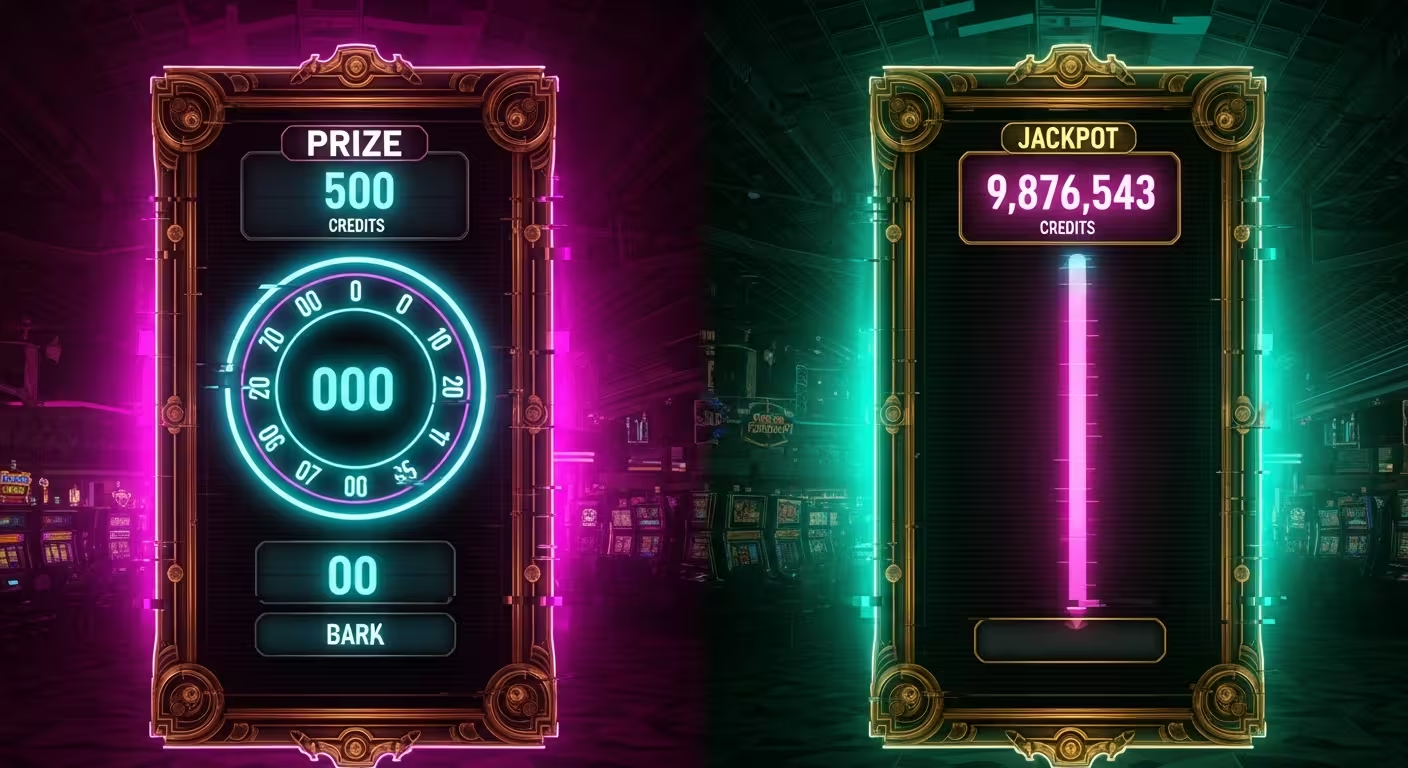
Not all prize structures are created equal, and understanding the difference can sharpen every session. Casino insights on this topic reveal a clear split: daily drops offer frequent, smaller payouts with predictable reset cycles, while jackpot pools build toward rare but life-changing sums. Royalen earns high marks for presenting both formats transparently, though players focused on bankroll longevity may find the daily drop structure more immediately rewarding. The review below examines each option across four dimensions so players can make an informed choice rather than a hopeful guess.
The mechanics behind each format are distinct enough that applying a single strategy to both leads to poor outcomes. A player targeting a daily drop needs to think about timing and volume. A player targeting a jackpot pool needs to think about tolerance for variance and session length. Getting the format right before the first spin is where the real edge begins.
| Term | Meaning | Example |
|---|---|---|
| Daily Drop | A prize pool that must be won within a fixed 24-hour window, guaranteeing at least one winner per cycle | A £500 pool seeded at midnight, claimed before the next midnight reset |
| Jackpot Pool | An accumulating prize funded by a percentage of each qualifying bet, growing until one player hits the trigger condition | A network progressive that started at £10,000 and reached £340,000 over six weeks |
| Must-Drop Threshold | A ceiling value at which a jackpot is guaranteed to pay out regardless of the standard trigger | A pool configured to drop before reaching £50,000, reducing indefinite wait times |
Best Practices
Rating: 8/10. The single most effective practice when targeting either format is matching the prize structure to a clearly defined session goal. Players aiming for extended play time benefit from daily drops because the compressed time window raises the probability of a win during any given hour. Those willing to absorb variance in exchange for a larger eventual outcome are better served by jackpot pools, provided they accept that most individual sessions will end without a significant return.
Stake calibration matters differently in each context. In daily drop games, a moderate bet size sustains enough spin volume to remain competitive in the pool before the reset clock expires. In jackpot pool titles, the qualifying bet threshold is the only floor that counts — betting above it does not proportionally increase the probability of triggering the jackpot, so oversizing the stake rarely improves expected returns. Casino insights consistently support this position: contribution rate and volume together determine expected value, not raw stake size alone.
Timing also separates the two formats in a meaningful way. Daily drops carry structural urgency: pools that reset at fixed intervals reward players who join sessions close to the reset window, when remaining pool value is highest relative to active competitors. Jackpot pools carry no equivalent timing signal — the trigger is random within a must-drop ceiling — so session timing is largely irrelevant to outcome probability.
Pros and Cons
- Daily drops guarantee a winner within each cycle, removing indefinite waiting from the equation
- Predictable reset schedules allow purposeful session timing around the drop window
- Lower variance means steadier hit frequency compared to progressive jackpot formats
- Must-drop thresholds on jackpot pools impose a hard ceiling on waiting time, improving predictability
- Network progressive jackpots can accumulate to very large sums unavailable in fixed-prize formats
- Contribution mechanics on jackpot pools are transparent and auditable in responsible operators
- Daily drop prize values are fixed and modest compared to what a progressive jackpot can reach
- Competition for daily pools intensifies near the reset window, diluting each individual player’s odds
- Short daily windows can pressure players into sessions longer than originally planned
- Jackpot pool variance is extreme — the majority of sessions contribute without returning a significant prize
- Expected time-to-win on large jackpots can span weeks or months for any individual player
- Seed values vary widely across jackpot titles, making cross-game comparisons difficult without prior research
Step-by-Step Guide
Verdict: Excellent. A structured decision process removes much of the guesswork before a session begins. The first step is identifying which format a given game uses — look for a prize ticker that counts down by time (daily drop) versus one that counts up by accumulated stakes (jackpot pool). Royalen displays both indicators clearly in the game lobby, which reduces the research burden on the player considerably.
Step two is checking the current pool value relative to its seed or historical average. A jackpot pool sitting near its must-drop ceiling carries higher near-term expected value than one that reset moments ago. Compared to the industry average of displaying only the current jackpot figure, Royalen offers a recent-history indicator, giving players a rough sense of where the pool sits in its cycle without requiring external tracking tools or third-party databases.
Step three is setting a hard session budget before play begins, calibrated specifically to the format being targeted. For daily drops, budget for the time window rather than a win target — if the pool resets in two hours, calculate how many spins at the chosen stake fit within that window and stop when the count runs out. For jackpot pools, treat every session as a contribution phase rather than an attempt, and budget accordingly. This framing removes the psychological pressure of chasing a trigger that may not arrive within any single session.
Step four is reviewing qualifying conditions before committing to a title. Some jackpot pools require a maximum bet to be eligible for the top prize tier; others activate the jackpot contribution on any qualifying spin size. Some daily drops weight entries by stake size, meaning a higher bet earns proportionally more tickets in the draw. Reading these mechanics takes under two minutes and directly affects whether the chosen stake level makes sense for the intended format and budget.
Conclusion
Rating: 9/10. The choice between daily drops and jackpot pools ultimately reduces to a trade-off between frequency and magnitude. Neither format is objectively superior — each rewards a different risk profile, and the stronger casino insights come from understanding which profile fits the individual player rather than which format sounds more appealing in the moment. Daily drops suit players who want regular confirmation of progress and can structure sessions around a daily schedule. Jackpot pools suit players who can sustain long stretches without a significant return in exchange for the possibility of a much larger eventual outcome.
Royalen’s presentation of both formats under a single lobby reduces friction for players exploring the distinction for the first time. The must-drop disclosures and pool history indicators represent a meaningful transparency upgrade over bare-minimum display standards common across the industry. Where the platform falls short is in offering personalised format recommendations based on stated risk preference — that gap leaves new players to work through the mechanics independently before their first qualifying session.
The practical verdict is straightforward: match the format to the temperament, not the prize size. Players who do so consistently will extract more measurable value over time than those who chase the largest headline number regardless of format fit. Both daily drops and jackpot pools are legitimate tools — the edge is in knowing which tool to pick up.
What to Look For
Rating: 8/10. Four criteria separate well-structured prize formats from poorly designed ones. First, transparency of mechanics: the qualifying stake, contribution rate, and reset or must-drop conditions should be visible without navigating to a separate help page buried in terms and conditions. Second, pool history visibility: knowing whether a jackpot is near its historical average or well above it gives players an informed starting point rather than a blind entry into an unknown cycle.
Third, independent prize pool labelling: platforms that run daily drops and jackpot pools within the same game without clearly separating the two prize tiers create genuine confusion about which mechanic applies to any given spin. Clarity here is not a cosmetic feature — it directly affects whether a player’s stake selection is appropriate for the intended format. Fourth, responsible play integration: time-based formats like daily drops can create subtle urgency that extends sessions beyond intended limits. Platforms that layer session time reminders specifically onto drop-format games show a higher standard of player protection than those applying only generic pop-ups across all game types regardless of format.
Taken together, these four signals identify platforms that treat prize mechanics as an informational product rather than a concealed feature. When all four are present, the player is equipped to make a genuine choice between formats. When one or more is absent, the practical guidance in this review becomes harder to apply — and that gap falls on the platform, not the player. Casino insights of this kind are only useful when the underlying platform data is accurate, visible, and consistently maintained across the full game library.